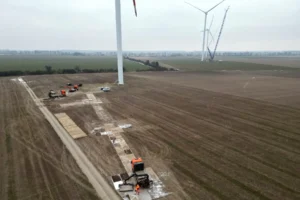





The development of the construction industry has a significant impact on how infrastructure, residential, and industrial investments are carried out. However, building new roads, houses, apartments, and plants is not possible without temporary roads. Their presence improves logistics, enhances safety, and also plays an important role in making the pace of work independent of the availability of resources.
Temporary Roads and Their Impact on the Construction Industry
Temporary roads in the construction industry are used as logistical connections between the materials yard, the construction site, and the municipal road. Depending on their design, they can support workers, heavy equipment, and—in some solutions—serve as a basis for temporary storage areas and warehouses. Temporary roads on the construction site work regardless of how muddy the ground is where they are installed. As the name suggests, they are temporary, so they are dismantled right after all work is completed.
What Benefits Come from Installing Temporary Roads?
What are the biggest advantages of temporary roads? They are access roads that keep communication routes passable, streamline transportation, and make the pace of construction work independent of surrounding conditions. So why is it worth building them?
Low Time Commitment and Easy Installation
Installing temporary roads is not time-consuming. They are usually made of interlocking, matched components that allow you to build two-way and one-way roads, as well as stacking yards, warehouses, etc. Construction roads can be assembled and disassembled quickly. This is possible thanks to their unique structure. What’s more, they also enable curves and turns, although the installation technology in this case depends on how the slabs are connected and on their sizes.
Independence
Access roads to the site make the pace of work independent of external factors. With them, you can prepare a larger buffer of selected construction materials to keep work continuous even when they are not available in stores or at depots. In addition, building access roads ensures efficient delivery of goods and equipment regardless of weather conditions. Moreover, access roads maintain their maximum throughput whether it is raining or snowing at a given moment.
Safety
Access roads increase the level of safety within the investment being carried out. Installing modular routes requires organizing traffic, preparing a set of rules for using the road, and also involves the need to submit a plan for building them to a specific office. This means that right from the start you can check whether the road will interfere with other road users’ lives and whether it will pose a risk to bystanders, including construction workers.
Reduced Environmental Impact
Temporary roads on the construction site are structures that do not pose any threat to the environment. Quite the opposite—they are usually built from materials that do not adversely affect the surrounding area. Steel, rubber, or wooden slabs do not contain harmful chemical substances in their composition. Some of them—such as wooden structures—are completely biodegradable. Meanwhile, slabs made from plastic materials can be processed using recycling methods.
Reliable Transport
The surface provided by temporary construction routes ensures optimal grip regardless of environmental conditions. These roads can be laid in mud or sand. Their surface is resistant to moisture, UV radiation, and many other factors. After the surface is in place, passenger vehicles, construction vehicles, and heavy equipment used to transport materials and people working on site can move on it, etc.
Low Cost
Temporary roads in construction are installed very quickly, which means the cost of building them and any potential dismantling is minimal. In general, temporary surfaces are available for rental, so there’s no need to produce or purchase them. Besides, that would be a significant burden for a company or a private individual. Moreover, they have a fairly large surface area, so storing them after completing the specified work would be pointless.
Easy Repairs
If modular roads on site are damaged, they can be repaired very quickly. You only need to replace a specific module and then attach it to the other elements of the road. It’s also worth noting that these structures have a high load-bearing capacity and resistance to damage and mechanical overloads. That means they can be used by both wheeled and tracked vehicles of practically any weight.
We encourage you to review the detailed technical specifications of our modular and temporary roads. We’re confident you’ll find a solution tailored to the needs of your construction site, as well as its logistical, terrain, and local conditions.