



Building temporary roads requires a bedding layer with a specific structure. Its density and thickness directly affect the integrity of the temporary road surface. So, what can you use to build supporting logistics infrastructure? Which materials are best for this?
Why use a base layer under temporary road surfaces
Temporary road construction – unlike traditional roads and highways – does not last for many years, giving you time to analyze soil cohesion, prepare the base layer, optionally dry the subgrade, and carry out other preparatory work. With temporary communication routes, we deal with solutions that:
- are built quickly to limit the costs of infrastructure construction and the investment itself,
- are often placed on ground with weak cohesion,
- are subjected to heavy loads from machines transporting goods.
The presence of a base layer has a real impact not only on the evenness of the surface, but also on the service life of the machines. Large jumps between prefabricated elements can damage the driving system and even make it impossible to transport goods and building materials. In addition, it’s important to remember that a solid base layer reduces the process of surface deformation, allowing it to still drain rainwater effectively.
Technical requirements for a temporary surface used by heavy equipment
The bedding used when laying temporary road slabs must meet a number of requirements that allow the surface to withstand the impact of heavy vehicles. These include:
- bearing capacity and stability – the sub-base layer should be strong enough to distribute the weight of vehicles evenly and prevent surface deformation,
- resistance to weather conditions – the base should withstand large temperature differences and maintain integrity under high humidity, rainfall, and freeze-thaw cycles,
- ability to drain water – drainage is essential to prevent water from collecting under the slabs, because excess moisture can cause settlement and reduce the structure’s strength.
What temporary road bases are made of – list and description of materials
What should you use to create a base under a temporary road surface? Here are several materials that will help you build a stable foundation for heavy equipment and transport vehicles.
- Gravel and other fine aggregates. This is a material that is very often used for the base layer. It is sufficiently plastic to distribute the load applied to the ground evenly. Typically, the thickness of the base created this way is around 10–20 cm. Gravel is also permeable to water.
- Crushed stone. Elements with sharp edges interlock with each other, increasing the stability of the soil. This material is recommended for areas with significant localized loads.
- Sand. With fine-grained sand, you can create not necessarily the entire base, but rather its drainage layer. Nevertheless, it works well in places that are not exposed to heavy loads (e.g., temporary roads and pedestrian routes).
- Recycled concrete. This is a material that often comes from demolition. It is easy to obtain, inexpensive, and fairly solid. One advantage of concrete is its eco-friendliness, since you can give “a second life” to unnecessary concrete structural elements from dismantled buildings.
- Fine asphalt. This is a material used primarily to improve the bonding of the aggregate used in the bedding. By using it as a binder, you can significantly strengthen the base structure, increasing its resistance to mechanical damage.
- Geosynthetic materials. To reinforce the subgrade under temporary roads, you can use geotextiles and geogrids that prevent the different layers of the base from mixing. The right geotextile increases the structural integrity of the soil, while a geogrid helps distribute loads more effectively.
- Aggregate mixes. To increase the integrity of the subgrade, aggregate mixtures of gravel and crushed stone are often used. Using different load-bearing and drainage materials together helps create a structure that makes it easier to distribute loads evenly.
What stages does construction of the base under a temporary surface include?
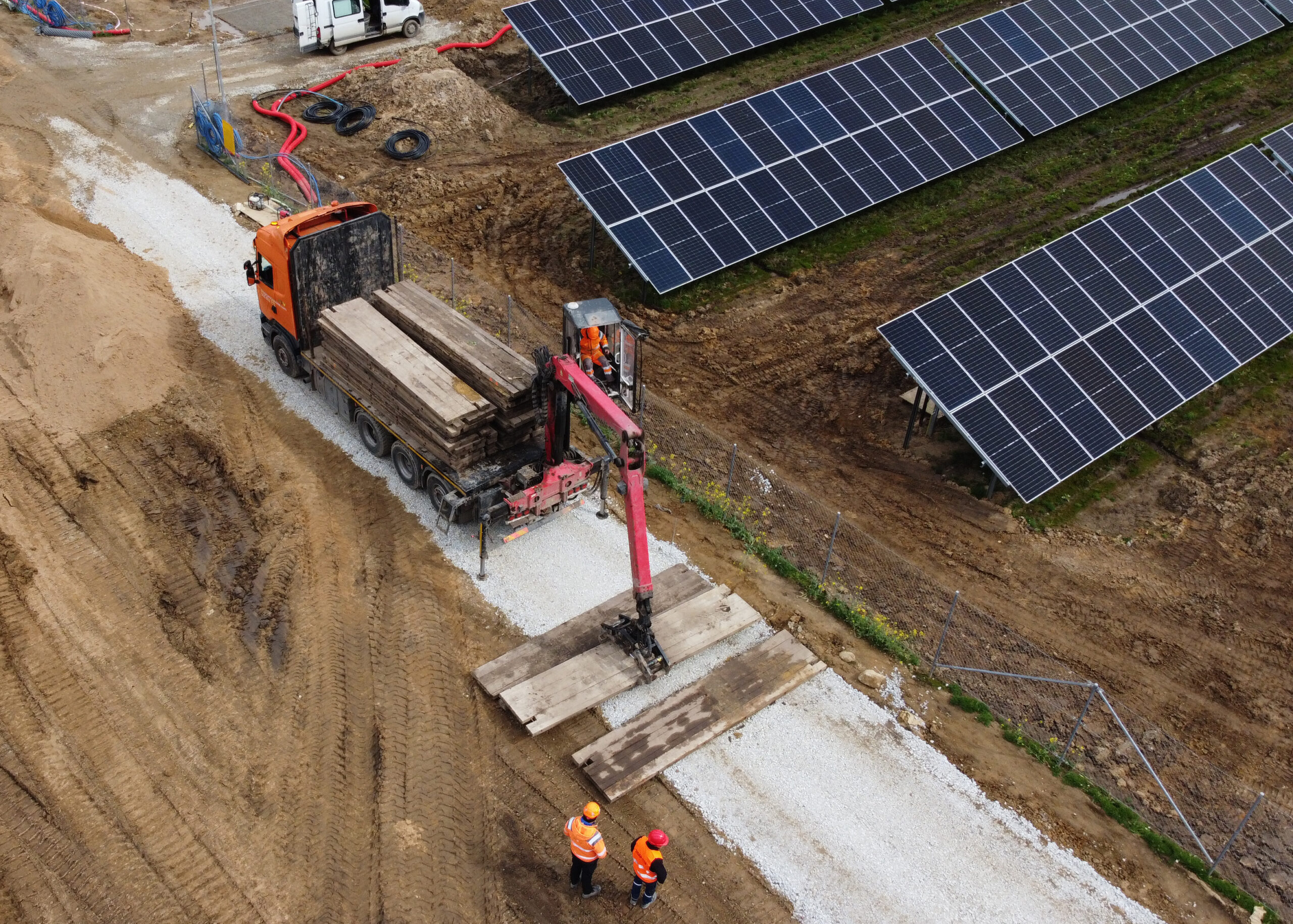
Building the base for temporary roads on a construction site consists of several stages. First, the area is leveled and cleaned using special land grading machines. Next, a drainage layer is laid to effectively carry away water. The next step is optional installation of geotextile as additional reinforcement for the subgrade. In the meantime, each layer is further compacted and reinforced so that the base’s bearing capacity reaches a specified value. The final stage is laying the road slabs. If gaps or leaks appear between the slabs, it’s worth securing them with sand or gravel.
Building a base under a temporary surface is a complex and time-consuming process, but thanks to it you can achieve bearing capacity measured in tens of thousands of kilograms.