



Work platform for a crane and SPMT – how road plates enabled the transport of resonance in a tightly built hospital area
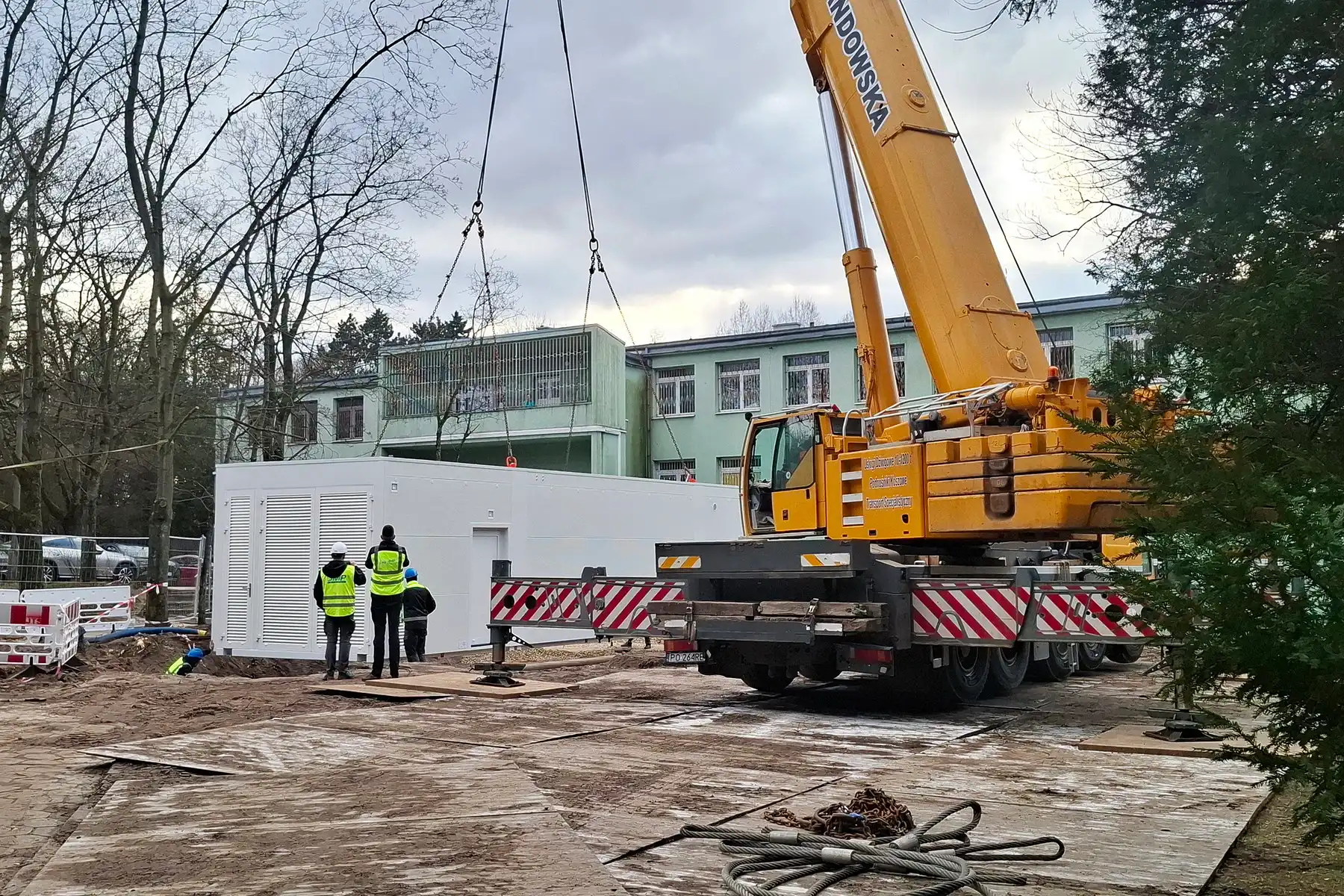
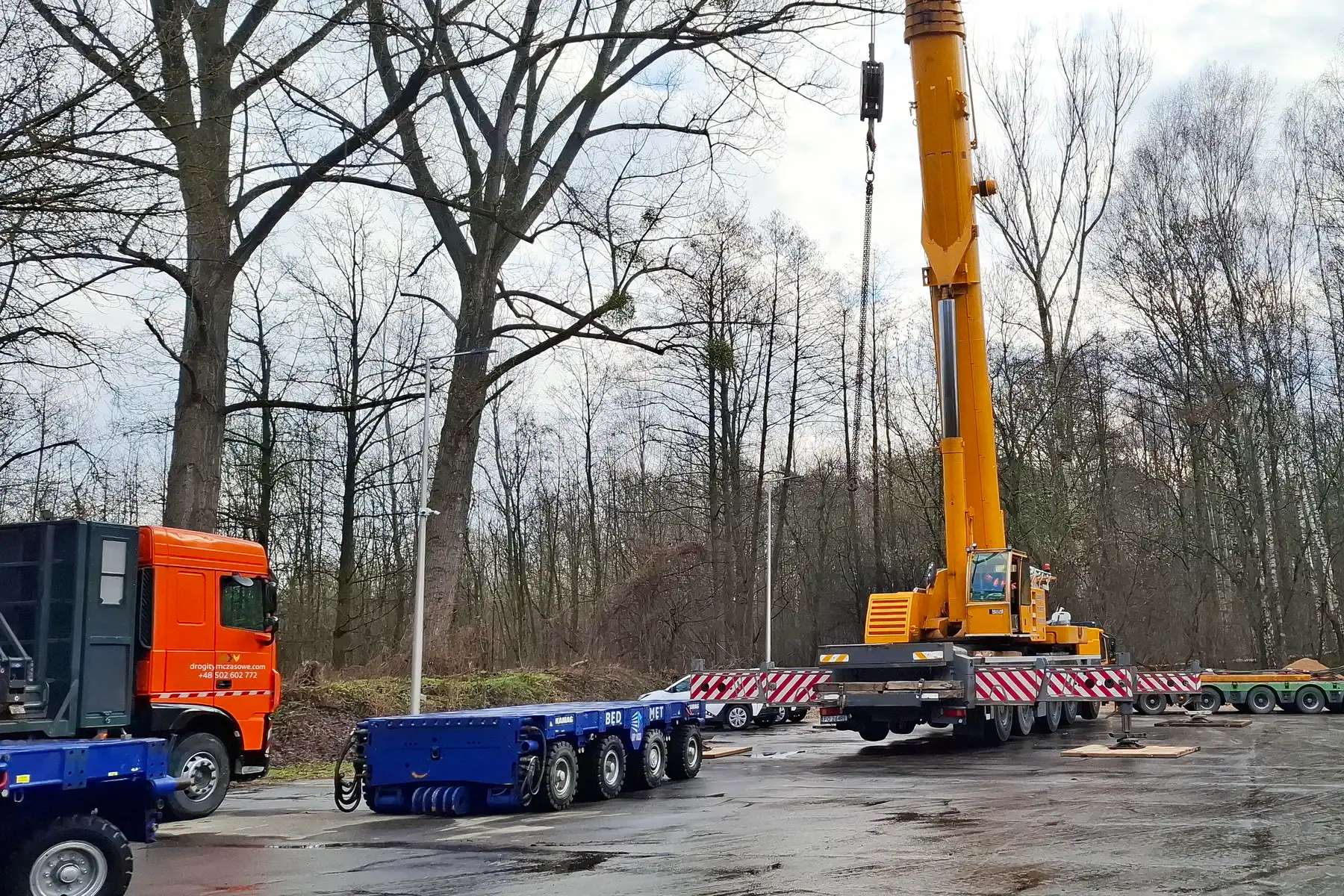
Transporting a modular magnetic resonance system weighing 30 tons to a hospital site is one of the most logistically demanding challenges faced by the oversize transport industry. Tight built-up areas, sensitive infrastructure, limited maneuvering space, and the need to use heavy equipment on a single timeline—each of these factors requires precise preparation of the ground surface. In this project, we were responsible for securing the ground for a multi-axle SPMT platform and the Liebherr LTM 1220-5.2 wheeled crane.
Why ground reinforcement is crucial when working with a crane and SPMT
Liebherr LTM 1220-5.2 class wheeled cranes generate extremely high point loads—both while driving and during operation with the boom under load. Although the SPMT platform distributes the weight across many axles, it still requires an even and stable surface along the entire travel route. On hospital premises, the challenge is further increased by existing underground installations, asphalt and concrete pavements not designed for industrial loads, and limited access for heavy installation equipment.
Without proper ground protection, carrying out this type of operation is impossible or involves a risk of damaging the pavement, technical infrastructure, or—in extreme cases—loss of stability of the crane.
Alu Deck HD as a work platform for the crane
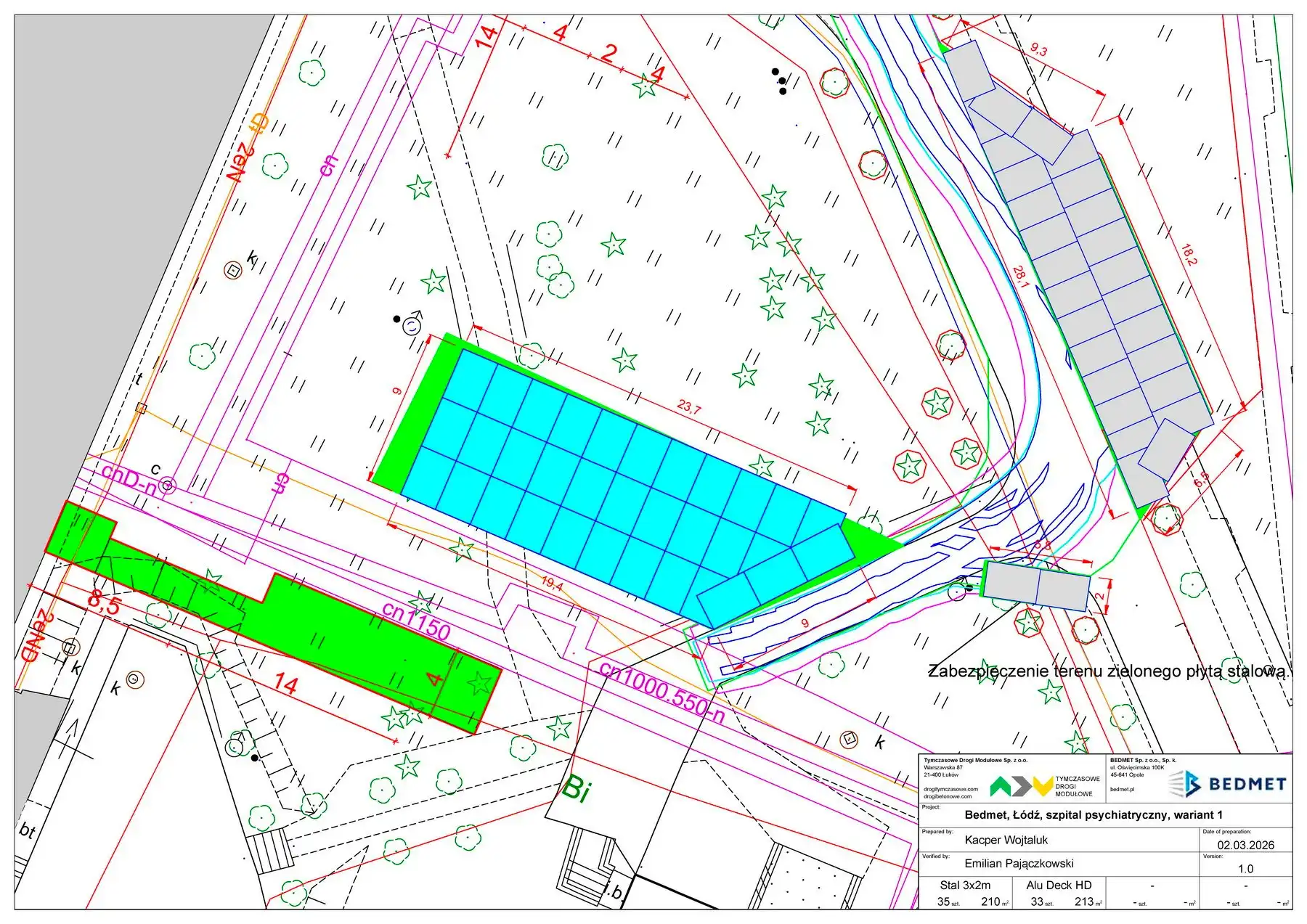
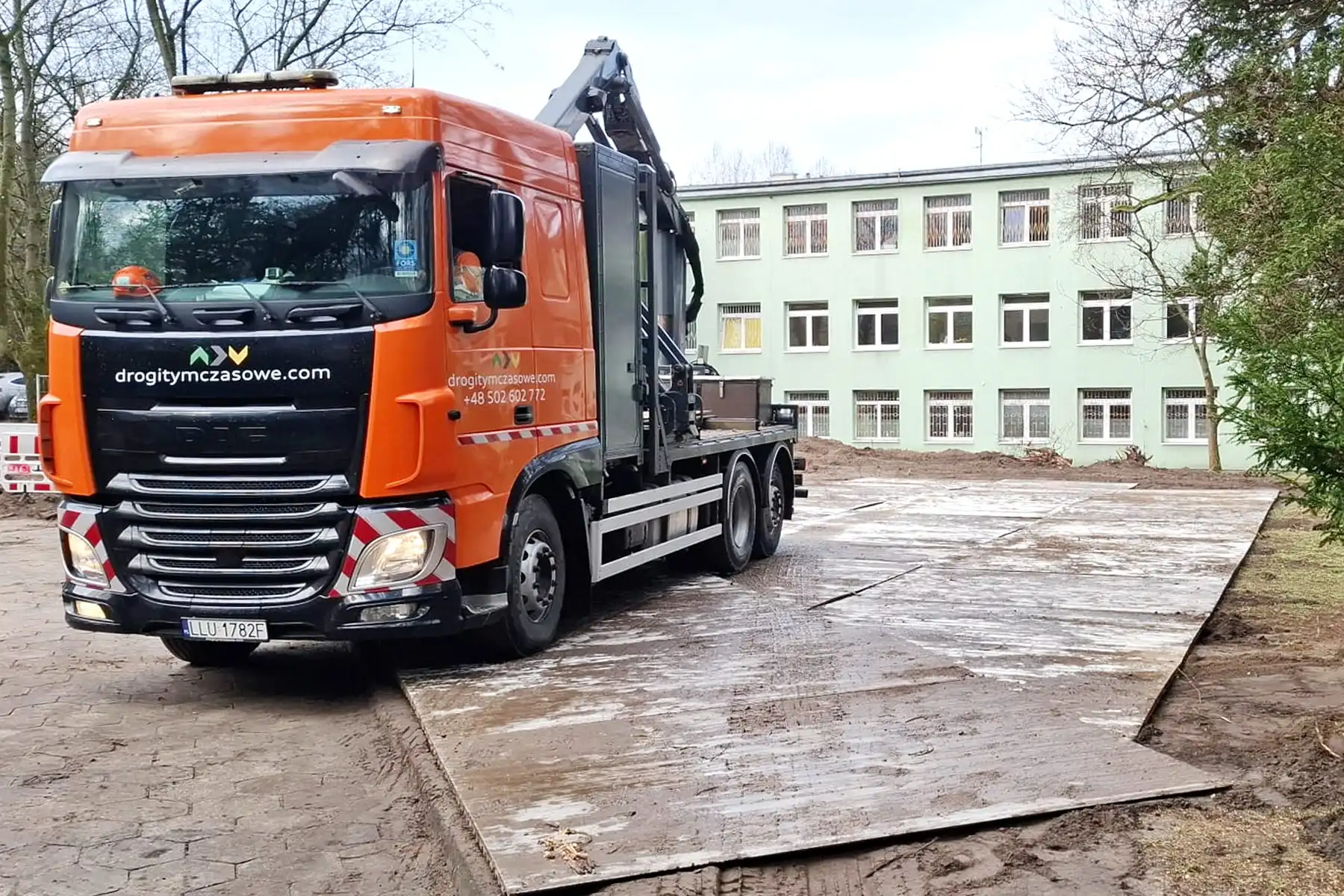
Within the crane work area, 213 m² of Alu Deck HD aluminum panels were laid out. The panel measures 215 × 300 × 5 cm and weighs 270 kg; it is designed for applications requiring maximum load capacity. Permissible static load is 200 t/m², and dynamic load—12 t per axle. The double-grooved surface effectively distributes point loads and protects the ground against deformation—an aspect that is directly relevant to operational safety when the crane works at full load.
Deeper ribbing and an anti-slip profile keep the plates stable even on wet or muddy surfaces. Installation using a telescopic loader or HDS makes it possible to cover over 500 m² of road within an hour—which is particularly important in conditions with limited time to prepare the site. A similar solution was used earlier for building a platform for a 250 t crane and for the project on Chmielna Street in Warsaw.
Steel plates for the SPMT travel route and the unloading area
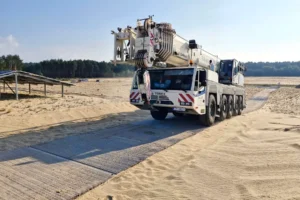
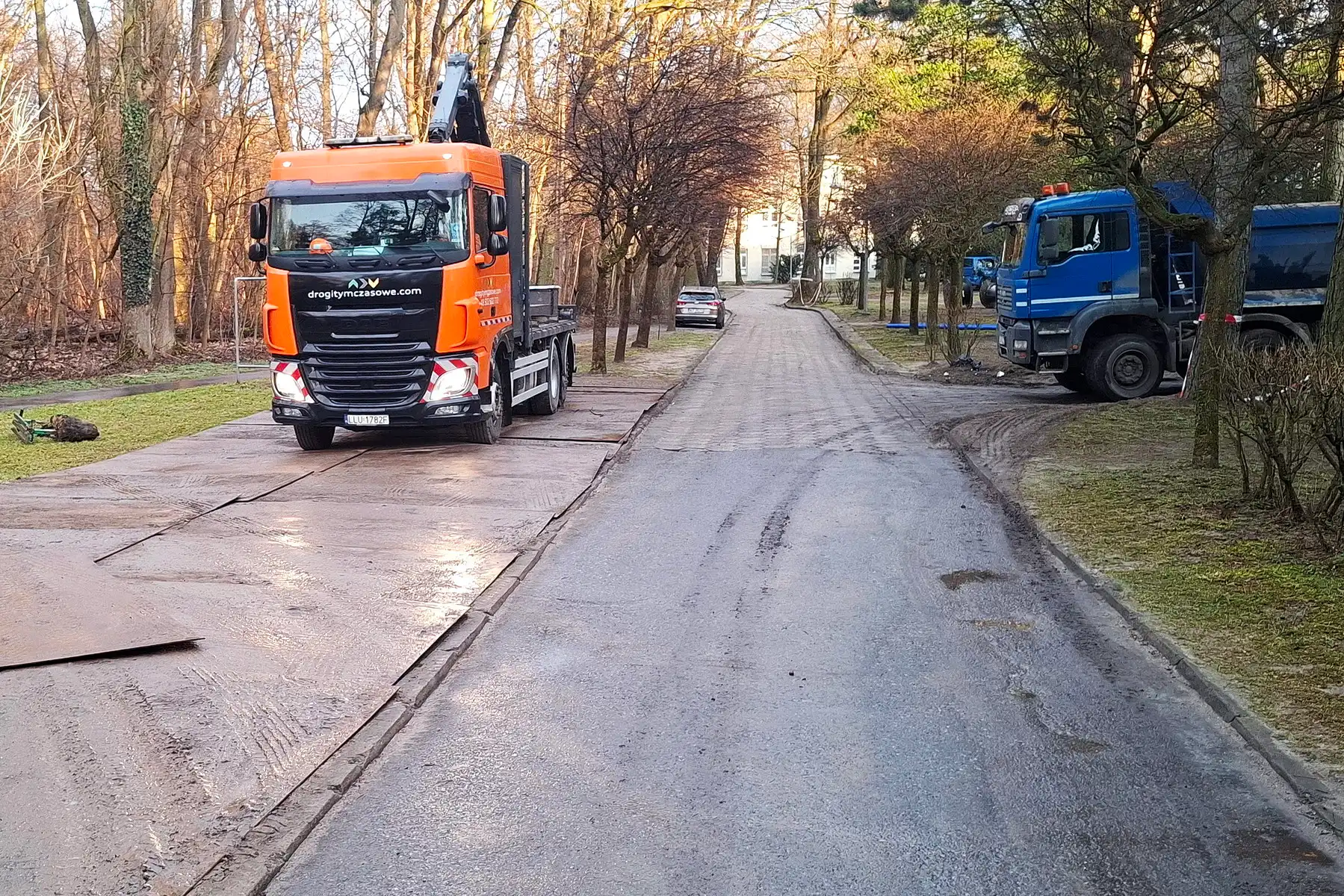
The SPMT travel route and the transfer (unloading) zone were secured with 210 m² of steel plates. Made from 10 mm thick sheets, available in sizes 200 × 300 cm and 150 × 300 cm. With the minimum thickness, they do not significantly raise the ground level—which, when working on an existing hospital pavement, eliminates the need to build ramps and crossings.
The steel sheet surface provides the highest resistance to abrasion and point loads, in this case from a multi-axle platform moving with a 30-ton load. Steel plates perfectly complement Alu Deck HD wherever continuous pavement is required along a long section of the route—not just a point platform under the crane supports. More about the use of this type of pavement in industrial projects is described on the page access roads for transport.
Rigging grid as a spacing element for the crane
The layout was complemented with Metrum wooden boards, used to precisely space the crane and level the ground in areas where using only aluminum or steel plates was difficult due to the terrain geometry. Metrum is available in lengths of 300, 400, and 500 cm with a width of 100 cm and a thickness of 10 cm, allowing flexible adjustment to any support layout.
Combining three types of boards—aluminum, steel, and wooden—made it possible to build a complete pavement protection system tailored both to the crane’s operating conditions and to the SPMT route in a limited hospital space.
Preparations took 5 months, execution—one day
The project required five months of planning: analyzing the bearing capacity of the ground, designing the equipment spacing, selecting the types and quantities of boards, and coordinating with Bedmet as the general contractor for transport and with Lewandowska, responsible for the crane. The final steps—delivery, loading, transport on the SPMT, and unloading of the resonance system—were completed within a single working day.
This is a delivery model where the quality of preparation is crucial. Similar coordination was required for our earlier projects—among others the transport of the ORP Sokół and ramps for structures weighing 4,000 tons. In all cases, properly selected temporary pavement eliminates the risk of delays and failures during execution.
Renting road plates for cranes and oversize transport
Securing the area for a crane, SPMT, or other heavy equipment is possible both in open areas and in urban or industrial developments. The choice of boards depends on the bearing capacity of the ground, the distribution of loads under the crane supports, and the requirements for the travel route. You can find the full offer on the page renting road plates—in every case, we provide transport, installation, and technical consulting on-site at the project location.
Contact us for pricing and equipment availability.